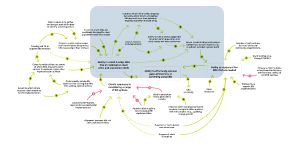
What impacts a clinic's ability to select and adapt EBIs impact?
Increasing a clinic’s ability to select and adapt EBIs that in combination meet their specific needs, increases the clinic’s capacity to strengthen their EBI approach over time. This happens because if a clinic selects the best suited EBIs initially, the EBIs are more likely to be effective and only require moderate changes over time. Similarly, selecting and adapting the most appropriate and best fit EBIs initially, and then strengthening them over time as necessary, increases the extent to which EBIs can address multilevel success factors.
A clinic’s capacity for systems thinking is also important to consider. Systems thinking capacity increases the overall understanding of factors that influence CRC screening in the context of a specific clinic, which allows the clinic to select the most suitable EBIs. An increased understanding of the system also helps the clinic to better strengthen EBIs over time and adapt EBIs to better match their needs. Adapting EBIs to better match the needs of a specific population, increases the extent to which the EBIs can address multilevel success factors.195, 198, 318, 323
Cited references for this diagram
Second, each EBI was modified to fit the needs and staffing model for this health system, which may have improved efficiency and impact.
This study demonstrates that EBIs to increase CRC screening may be effective in clinics with fewer resources that serve populations who have poor access to or under-utilize health care services. Tailoring the EBIs to the needs and capacity of participating clinics may have been key to their effectiveness.
The EBIs used in the CRCCP can be implemented differently, and practitioners can benefit from ensuring that the interventions are appropriate for their unique clinic population and context.
The study findings support that clinics may choose to implement strategies best suited for their unique circumstances and availability of resources.
