
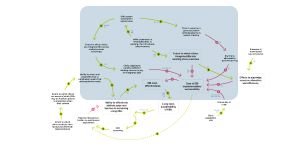


Cited references for this diagram
During interviews, respondents discussed benefiting from increasing use of automated patient messaging systems while responding to COVID-19 to disseminate CRC screening reminders and establishing or streamlining FIT kit standing orders to reduce burden on heavily strained clinic staff.

A key lesson learned was the importance of having high-quality electronic systems in place that can support tracking patients in real time to avoid the need for large amounts of staff time to manually track patients for CRC screening programs. In this study, FQHCs with efficient tracking processes were able to implement client reminders that are likely to be highly cost-effective.
Several grantees also discussed electronic health records as a facilitator for EBIs that involved sending information to clients and for the provider-oriented EBIs.
Participants discussed programs providing braided funding—a process that involves coordinating separate funding streams from multiple programs, such as CRCCP and NBCCEDP—to pay for common activities such as patient navigation across programs, provider reminders, and patient reminders (e.g., reminders for breast, cervical, and CRC screening).
The ability to access and share accurate patient information, including EHR data, was identified as another factor supporting readiness for integrated implementation of CRC screening.
Participants indicated that the clinic staff, particularly patient navigators and care coordinators, rely on the availability of accurate EHR reports to identify patients for screening and/or diagnostics for multiple chronic disease conditions. The clinic staff emphasized that the utility of the EHR data in supporting integrated implementation is contingent on data accuracy.
Similarly, data sharing among quality improvement (QI) teams promotes a collective understanding of where clinics stand on the delivery of health promotion activities that can foster understanding of opportunities to potentially improve these metrics through integrated implementation.
Fifth, the capacity and capabilities of the electronic medical records to support cancer screening by quickly identifying patients due for screening, tracking screening completion, and generating provider-level summary screening uptake were seen as critical for successful implementation and maintenance.
