
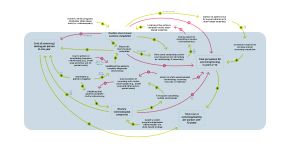


Cited references for this diagram
Currently, CDC's patient navigation policy requires that PNs deliver the following six activities: 1) assessment of patient's barriers to cancer screening, diagnostic services, or initiation of cancer treatment; 2) patient education and support; 3) resolution of patient barriers; 4) patient tracking and follow-up over at least two patient contacts to monitor completion of screening and diagnostic testing and treatment initiation; 5) collection of outcomes related to patient navigation (e.g., adherence to screening, diagnostic testing, and treatment); and 6) collection of patient-reported outcomes related to cancer screening, diagnosis, or treatment (Centers for Disease Control and Prevention (CDC); Centers for Disease Control and Prevention (CDC) and Division of Cancer Prevention and Control, 2019)

Results suggest that CRC PNs can increase follow-up efforts (e.g., reminder calls) for both fecal screening testing and colonoscopy as well as activities to address structural barriers.
Specific to screening provision, grantees using colonoscopy as the primary test (n = 12) reported that their navigators made reminder calls for colonoscopy appointments and for bowel preparation (both 92%), assisted patients in accessing bowel preparation materials (83%), tracked patients to ensure the procedure was performed (92%), and made follow-up calls after the colonoscopy to check on patients (83%).
For screening promotion, grantees reported navigators as having made reminder calls for colonoscopy appointments (83%) and assisted patients in accessing bowel preparation materials (83%). Only 56% of grantees reported that navigators made reminder calls to encourage patients to return FOBT or fecal immunochemical test (FIT) tests, although this may reflect fewer programs working with FOBT/FIT testing.
The largest time cost was related to bowel preparation and undergoing the colonoscopy procedure; therefore, potentially, noninvasive fecal-based tests could result in lower burden in terms of time lost. Fecal tests, though, require much more frequent screening than colonoscopy and, therefore, may not effectively save much money over the long term.
In this study, based on retrospective self-reports, patients spent, on average, 23.7 h preparing for, traveling for and having a colonoscopy, and an additional 5.1 h, on average, recovering from the colonoscopy. This translated into a total cost of $335.95 for the patient in lost time and $79.03 for the caregiver. In addition, an estimated $17.46 was incurred in travel and other costs. Even when colonoscopy is provided free of charge to the patient, additional costs may be incurred which could be a significant barrier for low income individuals to receive CRC screening.
Overall, the total cost of undergoing a “free” colonoscopy screening is substantial for a low-income patient, especially when the average hourly wage estimate used in this analysis for the patient was $11.68. This relatively high cost could explain the reason for the lower levels of compliance with screening recommendations among people with low education and generally low socioeconomic status (Centers for Disease Control and Prevention, 2013).
Although the authors found that direct clinical costs were higher for colonoscopy-only screening programs than for FOBT/FIT-only programs, nonclinical costs did not vary by screening test type, suggesting that these programs have substantial fixed costs.
Implementation of patient navigation and community health workers remained flat over time, likely due, in part, to the need for ongoing funding for staff.
Surveillance that occurs too frequently provides little or no benefit while exposing patients to the risk of complications, increasing costs, and wasting resources that could instead be used for primary screening. Waiting too long increases risk of disease progression to a point where treatment may be less effective.
Based on a single screening cycle for FOBT, screening with FOBT, including colonoscopy follow-up, was less costly than colonoscopy, both per person and per program.
The clinical cost of colonoscopy was almost 5 times the cost of FOBT/FIT per person when screening and diagnostic follow-up tests were included. Therefore, programs that use colonoscopy will only be able to screen about one-fifth the number of people that FOBT/FIT programs can for the same level of funding in the initial years of the program. This cost would only affect the number of people screened in the short term because colonoscopy is recommended every 10 years for those at average risk and with normal results, whereas FOBT/FIT is recommended to be performed annually. The clinical costs over a 10-year period for colonoscopy and FOBT/FIT may not be substantially different.
