
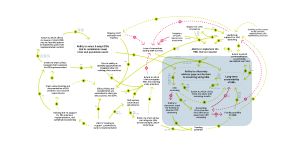


Cited references for this diagram
Early results from our PY1 evaluation, including changes in screening rates, suggest the CRCCP is working; program reach was measurable and substantial, clinics enhanced EBIs in place or implemented new ones in clinics, and we observed an increase in the overall average screening rate.

Studying factors associated with maintaining or abandoning the EBIs will create a catalog of lessons learned that can be shared among grantees to help them increase effectiveness in selecting and implementing EBIs.
Other frequently mentioned barriers [to EBI implementation] included getting approvals or arranging contracts with partner agencies and concerns about funding and sustainability.
A couple of grantees also noted a shift in their partners’ focus or priorities that led to the partner no longer being interested in the EBI.
Few grantees provided reasons for discontinuing specific EBIs. Of those who did, a common reason given (especially in program year 6) was the end of funding to sustain the EBI.
Implementation readiness — an organization’s combined capacity, commitment, and willingness to implement a new program, policy, or practice — facilitates implementation success.16–18 Because public health resources are limited, identifying a clinic’s readiness to successfully implement and sustain interventions, as well as gaps in clinic resources or practices that need to be addressed before implementation, is critical. Such assessment practices can guide clinics to select interventions with the greatest potential for long-term sustainability, and in turn help maximize the impact of public health spending, optimize clinic success, reduce cancer disparities, and improve population health.
Only 58% of clinics reported having good leadership support to maintain implementation of CRC screening EBIs, including mailed fecal testing. Fewer clinics reported having funding stability, organizational capacity, or the ability to adapt practices to ensure sustainability of EBI implementation. Although the CRCCP and other programs are designed with sustainability as a long-term goal, sustainability is an on-going challenge in clinics with limited resources and changing priorities that are reflected in budget changes.
Over half of clinics (58%) reported having leadership support to a great/very great extent to sustain the implementation of EBIs after the CRCCP screening initiative ends, but only 29% reported having a great/very great extent of funding stability in place to do so (Table 7).
Third, the effectiveness of these EBIs on CRC order and screening uptake was significant across all populations served and independent of insurance status.
Initial investments may discontinue following short-term improvements to population health outcomes, after which implementation of evidence-based practices can diminish, resulting in loss of preliminary program gains (Birken et al., 2020; Buchanan et al., 2005; Stirman et al., 2012).
All four priority EBIs were positively associated with clinic screening rates with statistical significance (Table 3).
An earlier study reported a 4.4−percentage point increase in average screening rate after 1 year of CRCCP implementation,10 whereas this study observed an increase of 11.3 percentage points over 2 years. Results from this study suggest increased effectiveness of the EBIs with longer and possibly improved implementation in the second year after the initial start-up phase.
Overall, the average clinic-level screening rate increased by 11.7 percentage points from baseline (33.5%) to PY2 (45.2%).
Average clinic CRC screening rates generally increased when clinics implemented or enhanced any number EBIs or SAs compared to clinics that did not newly implement or enhance any EBIs/SAs.
Across all interventions and multicomponent interventions, increases in the overall FQHC screening uptake ranged from 4.9 to 26.7 percentage points. Each FQHC implemented interventions that increased CRC screening among its low-income population.
Implementation sites often differ in the types and combination of EBI(s) and SA(s) implemented, how the EBI(s) and SA(s) are implemented, and the amount of resources utilized for development and implementation. Therefore, comparison across programs should include an in-depth description or mapping of intervention processes to understand how programs are similar and how they differ to support future implementation efforts.
Screening uptake increased across all the sites during the implementation period, ranging from 7.1 to 18.9 % points.
