
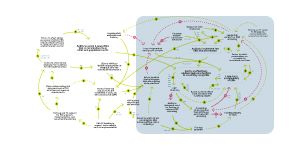


Cited references for this diagram
Third, support from clinic leadership is essential for continuing CRC screening promotion efforts and exploring innovative solutions to emergent challenges, especially when faced with limited clinic resources and staff capacity.42, 59

The other most commonly given reasons for stopping specific EBIs included limited staff time or staff turnover and the desire to implement other EBIs (and not being able to implement all EBIs at one time).
Across EBIs, many grantees mentioned successful partnerships as key facilitators to implementation. In many cases, grantees’ partners led implementation activities; in others, they provided connections, materials, or staff time.
Implementation readiness — an organization’s combined capacity, commitment, and willingness to implement a new program, policy, or practice — facilitates implementation success.16–18 Because public health resources are limited, identifying a clinic’s readiness to successfully implement and sustain interventions, as well as gaps in clinic resources or practices that need to be addressed before implementation, is critical. Such assessment practices can guide clinics to select interventions with the greatest potential for long-term sustainability, and in turn help maximize the impact of public health spending, optimize clinic success, reduce cancer disparities, and improve population health.
Only 58% of clinics reported having good leadership support to maintain implementation of CRC screening EBIs, including mailed fecal testing. Fewer clinics reported having funding stability, organizational capacity, or the ability to adapt practices to ensure sustainability of EBI implementation. Although the CRCCP and other programs are designed with sustainability as a long-term goal, sustainability is an on-going challenge in clinics with limited resources and changing priorities that are reflected in budget changes.
Over half of clinics (58%) reported having leadership support to a great/very great extent to sustain the implementation of EBIs after the CRCCP screening initiative ends, but only 29% reported having a great/very great extent of funding stability in place to do so (Table 7).
Unexpectedly, implementation of EBIs did not become easier over time, possibly because of the need to build and sustain partnerships over time with health care providers and organizations.
Given the limited nature of public health funding cycles, it is critical that health systems change efforts not only work to achieve population health outcomes but also dedicate time and resources to integrating effective strategies for increased likelihood of long-term sustainability. Integrating EBIs and SAs into existing FQHC processes proved essential to CRCCP sustainability.
Respondents stated that adopting a team-based approach to care facilitated sustainability by safeguarding FQHCs from losing momentum when staff turnover and fostering shared commitment to CRC screening.
Clear, visible leadership support helped facilitate sustainability by enabling institutionalization of EBIs and SAs within FQHCs. Champions leveraged external policies/reporting requirements (e.g., Health Resources and Services Administration Uniform Data System CRC screening performance measure) to make the case for sustained implementation of EBIs/SAs to upper levels of clinic administration.
Respondents in this study largely discussed the utility of integration within existing team-based care structures. Clinics without team-based structures in place prior to implementing a CRC health systems change effort may require additional support as they adjust to providing integrated services.
Respondents described aspects of FQHC communication and culture that bolstered early implementation, including the importance of identifying champions from varied roles (e.g., QI expert, physician) during FQHC recruitment or early implementation who could help prioritize CRC screening within FQHCs.
Whether champions served in leadership or other FQHC staff roles, their ongoing promotion of EBIs and SAs, and clear and consistent leadership support, was paramount to prioritize these efforts. CRC screening champions have been associated with increased CRC screening rates and higher overall clinic performance.
Clinic champions, also found to be more common in Q4 clinics, can play an important role in facilitating EBI implementation.
At the clinic level, a team-based approach was found to support staff ability to integrate implementation of EBIs and supporting activities to promote CRC screening with other patient care activities.
Finally, leaders’ expectations for integrated implementation can set the tone for clinic staff, creating a culture of readiness for the uptake of integration. For example, leadership support of CRC screening champions, individuals serving as internal advocates for screening, can help add credibility to champion activities.
Third, staff turnover was seen as a major barrier to both implementation success and sustainability. The burden consists of the need to train new staff, the loss of institutional knowledge, and the need to rebuild informal communication channels that are often required for coordination of multilevel interventions and supporting activities.
